Dr. Jung Min Bae, director of Heal House Gangnam Branch, has published a paper titled “Personalized Approaches to Facial Vitiligo: A Comprehensive Review From Clinical Phenotypes to Novel Therapeutic Strategies” in the October 2026 issue of Annals of Dermatology, an English-language journal issued by the Korean Dermatological Association and the Korean Society for Investigative Dermatology.
Director Jung Min Bae's Paper on ‘Tailored Treatment by Facial Vitiligo Type’ Published in the Annals of Dermatology
Facial vitiligo is classified into three types — mid-facial, generalized facial, and frontal-line-limited — and a tailored treatment approach is suggested for each.
For cases that do not respond well to excimer laser, surgical treatment with micro-punch grafting is proposed.
From newer treatments such as Rinvoq to relapse management, a comprehensive care system for facial vitiligo has been established.
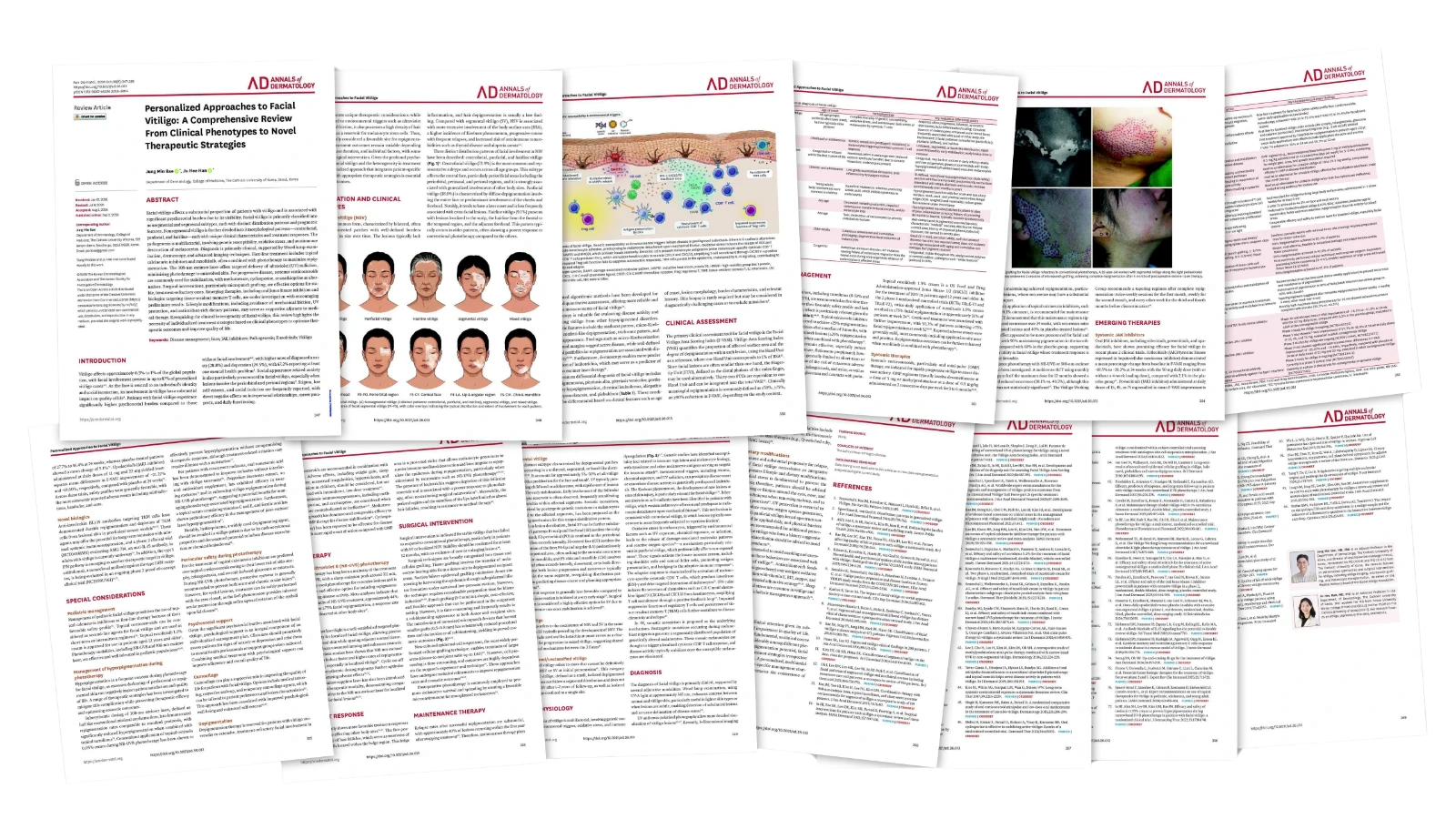
This paper, with Dr. Jung Min Bae as the corresponding author and co-first author alongside Professor Ju Hee Han of the Department of Dermatology at Seoul St. Mary’s Hospital, The Catholic University of Korea, establishes a clinical framework for facial vitiligo—from classification to the latest treatment strategies—based on years of research. It is particularly significant because it focuses specifically on facial vitiligo among all affected areas and provides direction for customized treatment by type.
Facial Vitiligo: A Heavy Emotional Burden
Vitiligo can appear anywhere on the body, but when it occurs on the face—always visible to others—the emotional burden on patients is much greater. According to the paper, up to 87% of patients with generalized vitiligo also have facial lesions, and these patients experience more anxiety and depression than those without facial involvement. It is understandable that lesions around the eyes or mouth can make social interactions particularly difficult.
Facial vitiligo is not just a skin condition; it affects patients’ daily lives and emotional well-being. For this reason, Dr. Jung Min Bae has made facial vitiligo a key research focus since his time as a university professor. He observed that even among facial vitiligo cases, treatment response varies depending on the location of the lesions. After extensive research, he has compiled the entire clinical process—classification, causes, diagnosis, treatment, and recurrence management—into this single review article. And the starting point of this entire process is the 'type' of facial vitiligo.
Even Facial Vitiligo Differs by Type
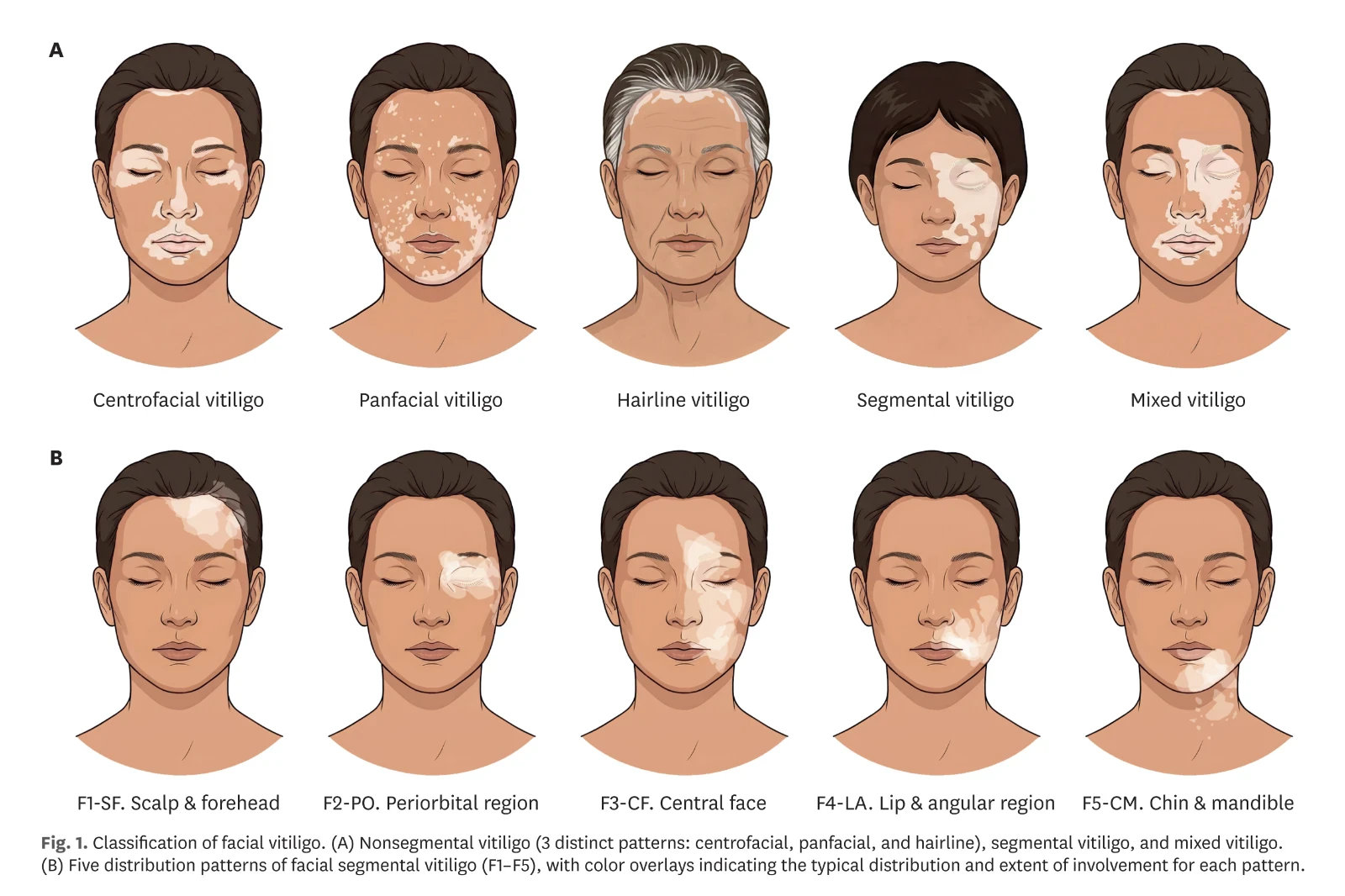
At the heart of the paper is the 'three facial vitiligo subtypes' classification, first proposed by Dr. Jung Min Bae in 2018 after analyzing data from 473 patients. The system categorizes lesions by their location and pattern into centrofacial, generalized facial, and hairline-limited types. The key finding is that each subtype has distinctly different causes, disease course, and treatment response.
The most common subtype is centrofacial vitiligo, accounting for more than 70% of all cases. Lesions typically appear around the eyes, nose, and mouth — areas that are repeatedly rubbed during washing or makeup removal. Reducing habitual rubbing or scrubbing is therefore important. Another characteristic is that vitiligo often also appears on other parts of the body.
Generalized facial vitiligo spreads widely across the face, mainly on the cheeks and forehead. It tends to start at a relatively later age, and lesions outside the face are less common. Since it develops on sun-exposed areas, sun protection is especially important.
Hairline-limited vitiligo appears along the hairline and scalp where hair begins, and it mostly occurs in older patients. It generally does not respond well to conventional phototherapy. If you have experienced worsening of symptoms after hair dyeing, it is advisable to avoid permanent hair dyes.
The paper also introduces segmental vitiligo, which appears as band-shaped lesions on only one side of the face, and further divides it into five distribution patterns. Knowing where and in what shape the lesions appear can help predict future progression and the likelihood of recurrence.
If Pigment Does Not Return with Excimer Laser, Micropunch Grafting Is an Alternative
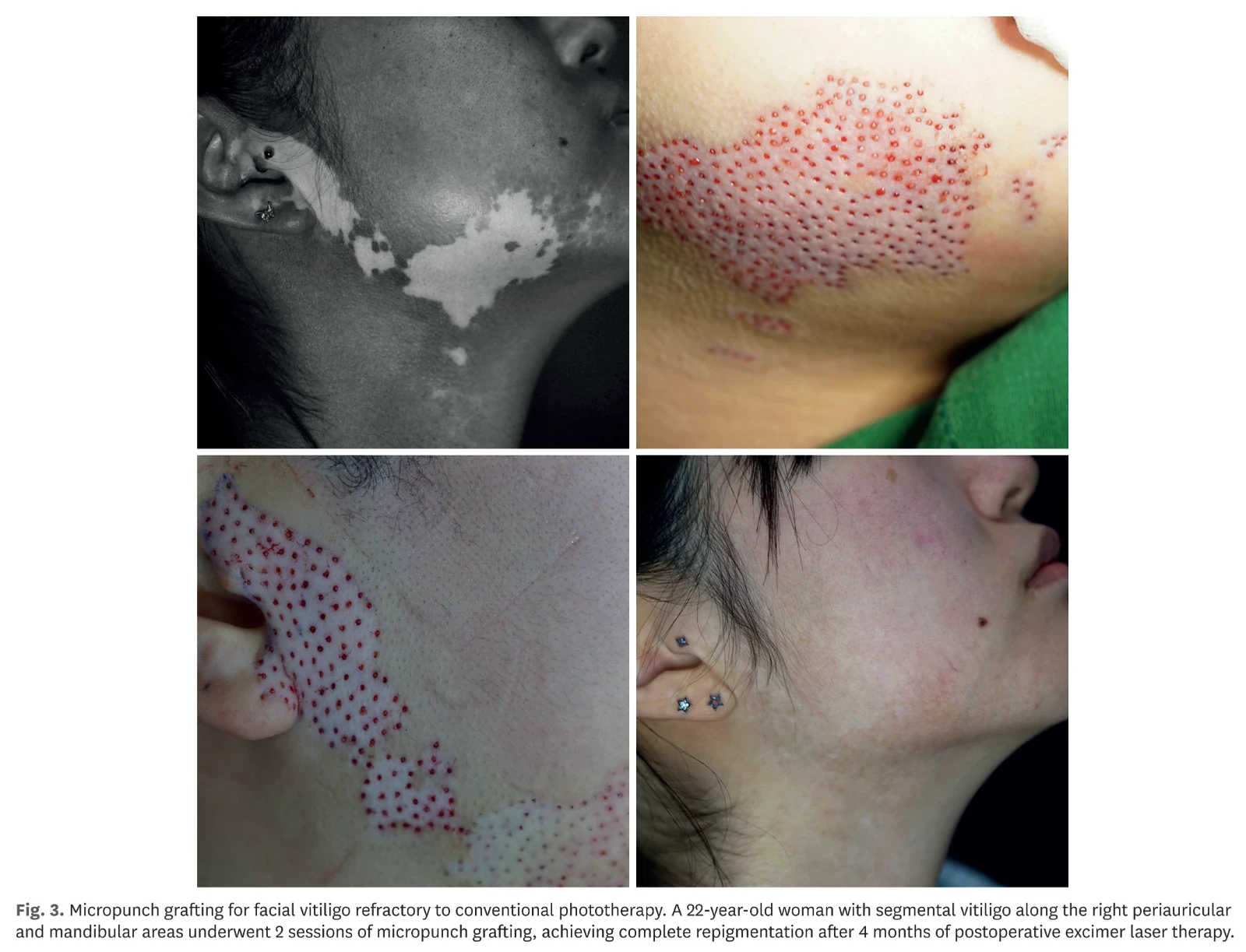
For refractory facial vitiligo that does not repigment despite consistent treatment with excimer laser or other standard therapies, surgical treatment with micro-punch grafting can be an effective alternative.
Micro-punch grafting involves taking very small skin grafts, 0.5–0.8 mm in size, from normal skin and transplanting them to the vitiligo-affected area. The use of motorized equipment has significantly shortened the procedure time, and the cobblestone-like scarring that was a drawback of conventional punch grafting has been noticeably reduced, making it well suited for cosmetically sensitive areas such as the face.
Actual treatment cases included in the paper illustrate the results in more detail. A 22-year-old female patient with segmental vitiligo extending from the right preauricular area to the jawline underwent two sessions of micro-punch grafting combined with excimer laser therapy and achieved complete repigmentation within 4 months.
From Introduction of the New Vitiligo Drug Rinvoq to Relapse Management
The paper systematically outlines the stepwise approach to treating facial vitiligo, from first-line topical therapies such as Protopic ointment, to targeted phototherapy including excimer laser, and systemic treatments used when the disease spreads rapidly. Among newer treatments, it introduces the oral JAK inhibitor Rinvoq (active ingredient: upadacitinib). Rinvoq is taken once daily and received its first approval in Korea in October for the treatment of nonsegmental vitiligo in patients aged 12 years and older.
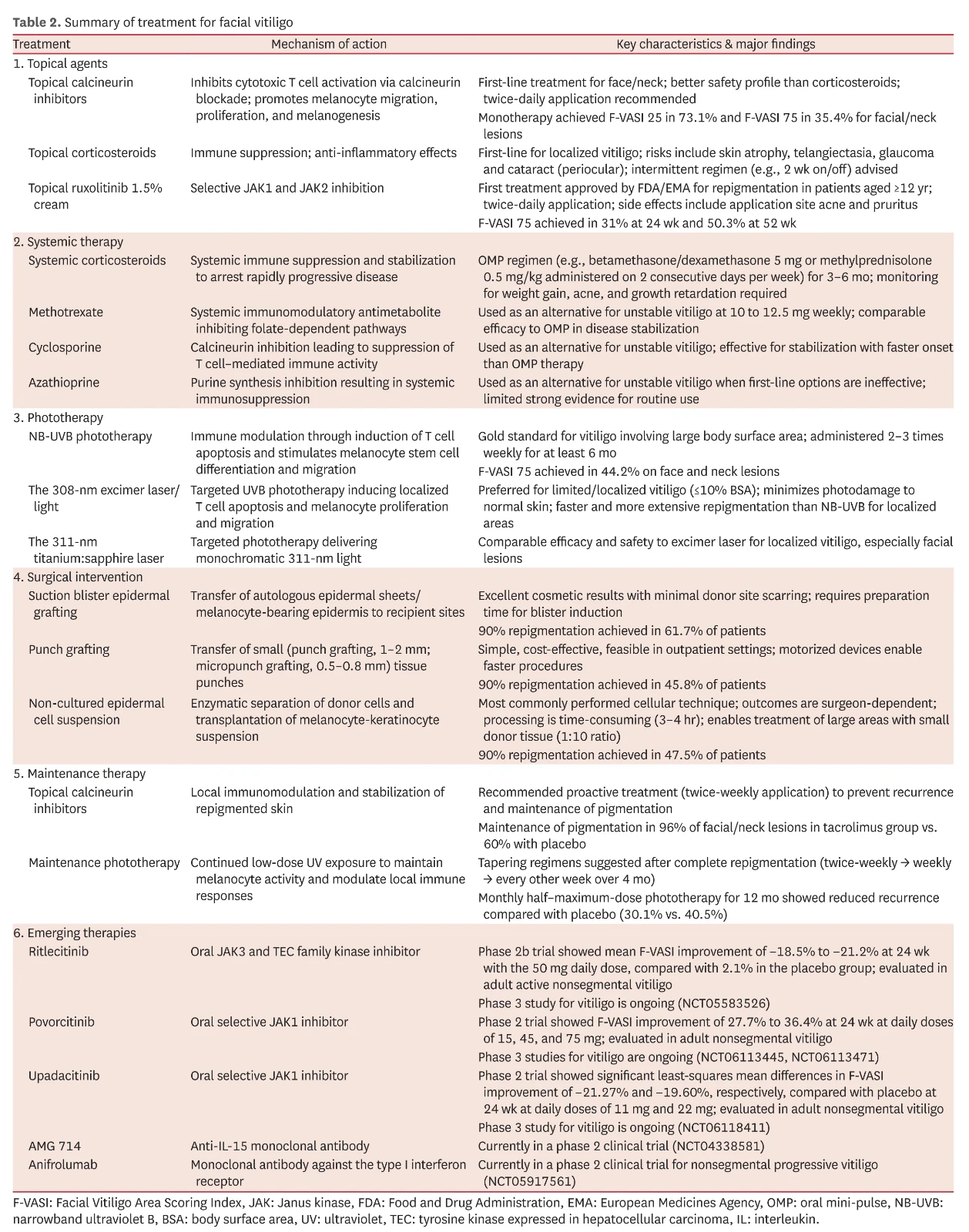
Post-treatment management is also essential. Even after successful repigmentation, approximately 40% of cases relapse within one year, so the paper emphasizes the importance of maintenance care after treatment.
Dr. Jung Min Bae explained, “The face has abundant hair follicles, so it tends to repigment better than other areas. Regardless of the condition on other parts of the body, it is worth treating actively.” He added, “Accurately identifying the type of vitiligo a patient has and establishing a treatment strategy tailored to that type is the starting point for good results.”
Dr. Jung Min Bae graduated from the Catholic University of Korea College of Medicine and earned his doctoral degree from the same university. He is currently the lead director of Heal House Dermatology and serves as a medical advisory board member of the Global Vitiligo Foundation.
Was this article helpful?